Lorem ipsum dolor sit amet, consectetur adipiscing elit ut liqua purus sit amet luctus venenatis, lectus magna.

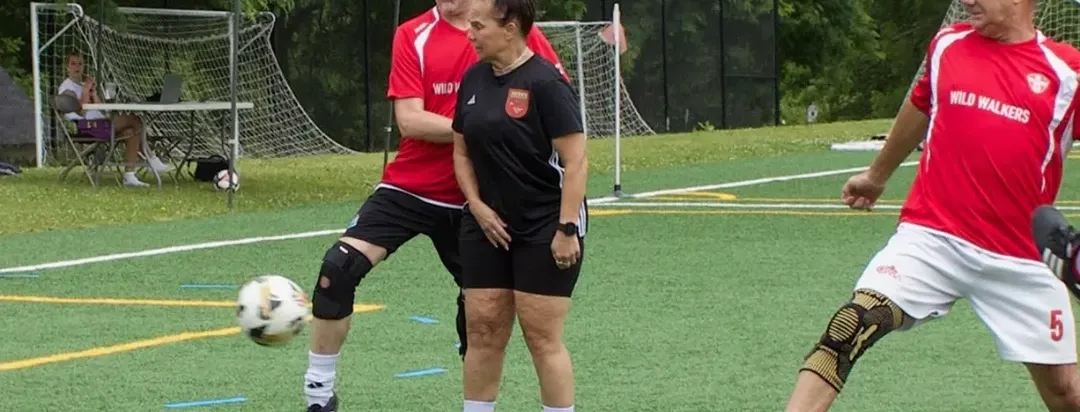
Walking soccer began as a way to keep lifelong fans active without the physical strain of standard play. Despite sharing the same objective, score more goals than the opponent, the two formats rely on noticeably different laws.
Below is a practical look at the most important rule differences, from how fast you can move to the size of the pitch. Whether you are joining a local walking league or organizing a mixed-ability match, understanding these tweaks will keep the game flowing smoothly.
Walking soccer is played under the principle that one foot must remain in contact with the ground at all times. This single adjustment changes how every other aspect of the game unfolds.
Governing bodies like the Walking Football Association in the UK provide standardized laws, but small local variations are common. Always check competition guidelines before kickoff.
In regular soccer, sprinting to space or closing down an opponent is essential. Walking soccer bans any running, jogging, or skipping. The referee calls an indirect free kick for violations, often issuing a verbal warning for a first offense.
The rule not only reduces injury risk but also levels the field for players with different fitness levels. Anticipation and positioning replace raw speed as decisive factors.
Walking soccer is officially a non-contact sport. Shoulder-to-shoulder challenges, slide tackles, and blocking runs are prohibited. Instead, defenders must rely on intercepting passes and shepherding opponents away from danger zones.
Traditional soccer permits fair shoulder contact and sliding, provided the tackle is clean and the ball is played first. Removing these elements in walking soccer sharply lowers collision risk.
Walking leagues usually play on smaller pitches, roughly 20 to 40 yards wide and 30 to 60 yards long. Teams often field five to seven players, though some competitions allow up to nine.
Goals are also scaled down, commonly measuring 3 feet high by 5 feet wide, which encourages accurate passing over driven long shots. Standard soccer fields and full-size goals remain the norm in the traditional game.
A typical walking soccer match runs two 20-minute halves with a brief halftime. Many leagues build in rolling substitutions so players can rest as needed.
Regular soccer at adult levels features two 45-minute halves and limits subs, demanding greater endurance. The shorter sessions in walking soccer keep fatigue and overuse injuries at bay.
Most walking soccer laws cap ball height at or below shoulder level. Any clearance or pass that exceeds the limit results in an indirect free kick to the opposition at the spot of the infraction.
The restriction reduces high-speed aerial duels and lowers the chance of accidental collisions. In regular soccer, lofted passes, headers, and goal kicks are integral parts of tactical play.
Offside is commonly removed in walking soccer to simplify play and maintain inclusivity, although some advanced leagues may reintroduce it. Free kicks are always indirect, and penalties are awarded sparingly when clear goal-scoring opportunities are denied.
Regular soccer continues to use the full offside law, direct and indirect free kicks, and standard penalty procedures. These complexities demand higher levels of tactical awareness and referee involvement.
Players recovering from injury, older athletes, and newcomers often gravitate toward walking soccer because it minimizes strain without removing the fun of competitive play.
Community clubs also find the format useful for mixed-ability sessions, family events, or offseason conditioning. By tweaking a handful of rules, the game welcomes a broader audience while preserving the spirit of soccer.
Walking soccer succeeds by keeping the essence of the sport, passing, positioning, and teamwork, while stripping away high-impact elements that can sideline participants.
If you love the beautiful game but prefer a gentler experience, these rule changes make walking soccer an inviting option. Know the differences, lace up your trainers, and enjoy the match at your own pace.
Gametime Hero is the AI-powered operating system for active communities.
If you're organizing a community and tired of the chaos, start here
You know your community best — we know how to help it thrive.
You're already doing the hard part: building a community people care about. Gametime Hero gives you events, registration forms, a custom website, payments, scheduling, and communications — so you can stop juggling tools and start scaling.
Whether you run a weekly pickup group or a multi-season league, we'll walk you through exactly how it works for your setup.


Explore our collection of 200+ Premium Webflow Templates